
-
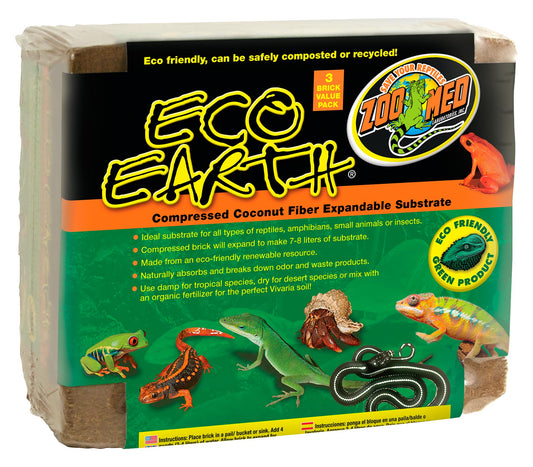
Pressed coconut fiber substrate
Regular price From €4,95Regular priceUnit price per -
Regular price From €4,95Regular priceUnit price €4,95 per l
-
Regular price From €4,95Regular priceUnit price per
-
Calcium sand 4.5 kg (for desert reptiles)
Regular price €15,95Regular priceUnit price €3,54 per kg -
 Sold out
Clay substrate (burrowing reptiles)
Regular price From €15,95Regular priceUnit price €3,54 per kg



Which substrate should you use in a terrarium?
Terrarium substrate is chosen according to the animal's natural habitat: dry for desert reptiles, damp for tropical species and specific substrates for snakes, burrowers or beetle larvae. These are the substrates in this collection and what each one is for:
- Calcium sand: desert terrariums, such as those for bearded dragons, leopard geckos, uromastyx or tortoises.
- Compressed coco fibre: tropical, humid terrariums, for crested geckos, chameleons, anoles, frogs and invertebrates.
- Aspen (poplar shavings): dry, well-ventilated terrariums, especially for snakes.
- Clay: burrowing reptiles that dig their own tunnels.
- Flake Soil: rearing the larvae of giant beetles and stag beetles.
For isopods we use our own mix of coco fibre, all-purpose substrate, vermiculite and garden soil, explained in our isopod guide.
What is the best substrate for snakes?
The most widely used substrate for snakes is aspen, a wood shaving from poplar (Populus) with no oils or resins, unlike cedar or pine shavings, which can be toxic. Aspen Snake is 99.9% dust-free, which protects the snake's respiratory system and improves air quality in the terrarium.
It is a substrate for dry, well-ventilated terrariums, suitable for species such as the corn snake (Pantherophis guttatus) or king snakes (Lampropeltis spp.). It absorbs moisture, controls odours and makes cleaning easier, and its light, soft texture is ideal for resting and nesting areas. It is also suitable for rodents and other small animals. It is sold in 4.4, 8.8 and 26.4 litre bags, from €4.95. It is not suitable for tropical species that need a damp substrate: for those, coco fibre is a better choice.
How do you use coco fibre in a terrarium?
Coco fibre for terrariums is sold compressed into bricks: it is hydrated with water and expands to up to 8.8 litres per 600 g brick. It is natural coconut husk, free from chemicals and pesticides, and its main advantage is that it retains moisture very well, which is why it is the usual base for tropical terrariums.
It is suitable for reptiles such as the crested gecko (Correlophus ciliatus), chameleons and anoles; for amphibians such as dart frogs, tree frogs and toads; and for invertebrates such as phasmids, mantises, beetles, tarantulas and isopods. It is sold individually or in packs of 3 bricks. Once in place, it is kept moist by misting, without waterlogging it, and with good ventilation to prevent mould. For isopods, coco fibre makes up half of the mix we use in our breeding: 50% coco fibre, 40% universal substrate, 5% vermiculite and 5% garden soil.
Which substrate should you use for desert and burrowing reptiles?
For desert reptiles, the most common substrate is calcium sand: its ultra-fine grain reduces the risk of gut impaction if the animal swallows some by accident, which happens often in species that explore with their mouths or eat off the ground. It is enriched with vitamins and beta-carotene, does not compact and does not produce dust. It is suitable for bearded dragons (Pogona vitticeps), leopard geckos (Eublepharis macularius), uromastyx and tortoises.
For burrowing reptiles, which build their own tunnels, there is natural clay substrate, with no additives or dyes. You add water, let it soak in and then shape it into tunnels, dunes or hides; once dry it holds its shape without collapsing. To stop it cracking, dampen it lightly from time to time. For example, it lets you build a burrow where your reptile can dig just as it would in the wild. Calcium sand is sold in 4.5 kg bags and clay in 4.5 and 9 kg, subject to availability.
Which substrate do beetle larvae need?
The larvae of giant beetles and stag beetles (families Lucanidae and Dynastinae) need Flake Soil, a fermented substrate that is both their home and their food: fermentation provides the nutrients they need to grow. It is ready to use, you just add water, and it should not be mixed with other substrates because that upsets its biological balance.
Moisture is the key with Flake Soil. The test is simple: when you squeeze a handful, it should keep the shape of your fist without water dripping out. Check it regularly and dampen it when needed, without overdoing it. It is sold in 1, 5 and 10 litre bags, from €4.95. It is the right substrate, for example, for rearing species such as the rainbow stag beetle (Phalacrognathus muelleri), one of the most spectacular beetles thanks to its metallic green, red, blue and purple sheen. The beetle species are in other invertebrates.