
-
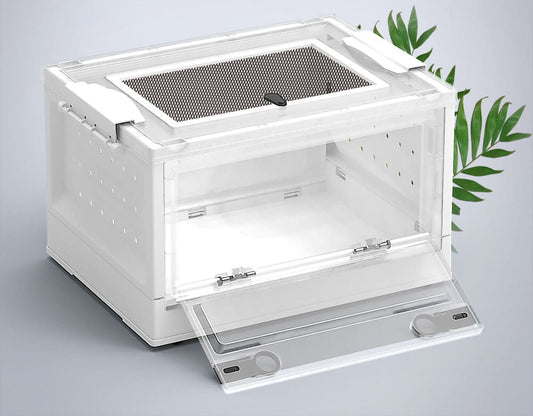
Plastic terrarium for reptiles 30x40x24 cm
Regular price €34,95Regular priceUnit price per -
White PVC vertical terrariums with glass doors
Regular price From €54,00Regular priceUnit price per -
White PVC horizontal terrariums with glass doors
Regular price From €109,00Regular priceUnit price per€180,00Sale price From €109,00Sale



Accessories for your gecko's terrarium
-
Example product title
Regular price €19,99Regular priceUnit price per -
Example product title
Regular price €19,99Regular priceUnit price per -
Example product title
Regular price €19,99Regular priceUnit price per -
Example product title
Regular price €19,99Regular priceUnit price per
Which terrarium should I buy for a leopard gecko?
For a leopard gecko you should buy a horizontal terrarium with a footprint of at least 60 × 40 × 40 cm, because it is a terrestrial reptile that lives on the ground and needs length so there is a thermal gradient between the warm and cool zones. Height is not important: 40 cm is more than enough, and a tall terrarium only makes it more expensive.
The 40 × 40 × 80 cm white PVC horizontal terrarium meets that size for an adult leopard gecko (Eublepharis macularius), with 80 cm of length. It has 10 mm panels, sliding glass doors, cross ventilation and two cable ports for fitting ceramic lamp holders. It is best to choose the size for the adult animal from the start, to avoid changing terrariums, which stresses the gecko and upsets the parameters. Availability for each size is shown on the terrarium's product page.
Which terrarium should I buy for a crested gecko?
For a crested gecko you should buy a vertical terrarium of at least 30 × 30 × 45 cm, because it is arboreal and spends its time climbing, so it needs more height than floor space. The 30 × 30 × 45 cm white PVC vertical terrarium meets that minimum size for an adult crested gecko (Correlophus ciliatus); the 45 × 45 × 60 cm model gives it more space.
Crested gecko conditions are very different from those of the leopard gecko, and each species needs its own terrarium:
- Temperature: 22-26 °C during the day; it struggles if kept above 28-29 °C for long periods.
- Humidity: 60% to 80%, with drying cycles.
- Water: misting system or hand misting 1-2 times a day.
- Decor: caves and vegetation at height.
PVC or glass terrarium for geckos?
A PVC terrarium is one of the best options for geckos because it insulates heat well: the thermal gradient is more stable and electricity consumption is lower. It is also lightweight and easy to clean. A glass terrarium works too, but loses heat more easily, especially in winter, and requires more precise temperature control.
For a leopard gecko, terrarium humidity should be between 30% and 40%; chronically above 50-60%, respiratory infections appear. So, whatever the material, ventilation is essential. The PVC terrariums in this collection have cross ventilation, and the 30 × 30 × 45 cm vertical model also has top ventilation so lighting can be fitted outside without losing interior space. For temporary housing, quarantine or transport, the 29.5 × 39.5 × 24 cm folding plastic terrarium is a practical alternative.
What else does a leopard gecko terrarium need?
As well as the terrarium itself, a leopard gecko needs a heat source with a thermostat, hides, a moist hide for shedding and a safe substrate. These are the elements, according to our guide:
- Heat: a heat spot lamp that warms surfaces to 30-32 °C in the warm zone, with an optional heat mat underneath and always with a thermostat. See heating.
- Hides: at least two, one in the warm zone and one in the cool zone, plus a moist hide with damp substrate.
- Substrate: slate or tile for hatchlings; coco fibre or burrowing substrate for adults. Never loose silica sand. See substrates.
- UVB: recommended, a compact bulb or T5 5.0 tube giving a UVI of 1 to 2.
Step-by-step set-up is in our leopard gecko terrarium guide.
Related categories
-

Reptile supplements: calcium and vitamins
Calcium and vitamins for bearded dragons, geckos, chameleons, tortoises and other reptiles.
-

Products for reptiles and terrariums
Explore accessories, decor, and equipment for reptiles and terrariums, designed for their...

