What is a reptile heat mat for?
A reptile heat mat is a thin heating sheet that gives gentle, constant heat from the base or one side of the terrarium without emitting light. It simulates ground temperature, aids digestion and serves as night-time heat or as back-up in cool zones and in terrariums that retain little heat. It also uses little energy.
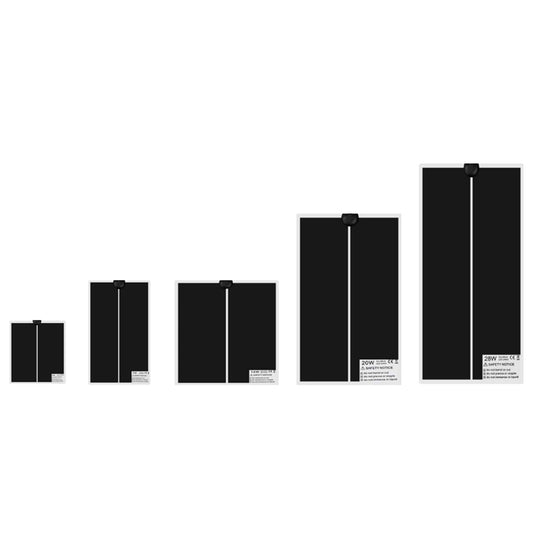
Our heat mat has a built-in power regulator and is available in five sizes:
- 5 W (14 × 15 cm) and 7 W (15 × 28 cm), for small terrariums.
- 14 W (28 × 28 cm) and 20 W (42 × 28 cm), for medium terrariums.
- 28 W (53 × 28 cm), for large terrariums.
The heat mat should never cover the whole floor: for the leopard gecko, for example, it is recommended that it covers between a third and half of the floor in the warm zone, so that the animal can move away from the heat. Nor should it be covered with a thick layer of substrate, as this makes it less effective.
Does a terrarium heat mat need a thermostat?
Yes: the thermostat is the basic safety element of a terrarium heat mat, and the mat must always be connected to one. A heat mat without a thermostat can exceed 40 °C on the substrate surface, and a reptile that cannot move away from the heat suffers belly burns that often go unnoticed until the damage is done. The power regulator included with our heat mat helps adjust the heat, but it does not maintain a constant temperature.
Setting it up is simple: the heat mat plugs into the thermostat, the thermostat into the mains, and the probe is fixed in the warm zone, at the point where the animal receives the heat, usually on the substrate or slightly within it. When the set temperature is reached, the thermostat switches the mat off. The digital thermostat with probe can be set from 16 to 40 °C with an accuracy of ±0.1 °C. The same applies to the ceramic heat lamp. You will find thermostats in thermostats and thermometers, and the full set-up in our leopard gecko terrarium guide.
Which reptile heat bulb should you choose?
The heat bulb is chosen depending on whether the reptile also needs light. The heat bulbs in this collection go in an E27 ceramic lamp holder, because they run at high temperatures, and come in three types:
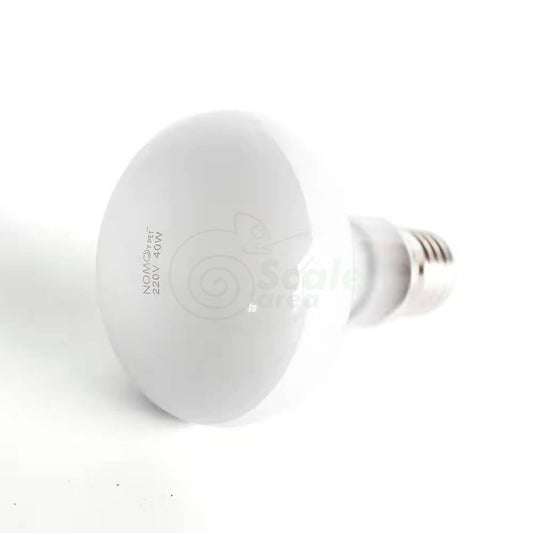
- Heat spot bulb (25, 50, 75 and 100 W): incandescent daylight bulb; it gives heat, visible light and UVA, and creates the basking spot for diurnal reptiles.
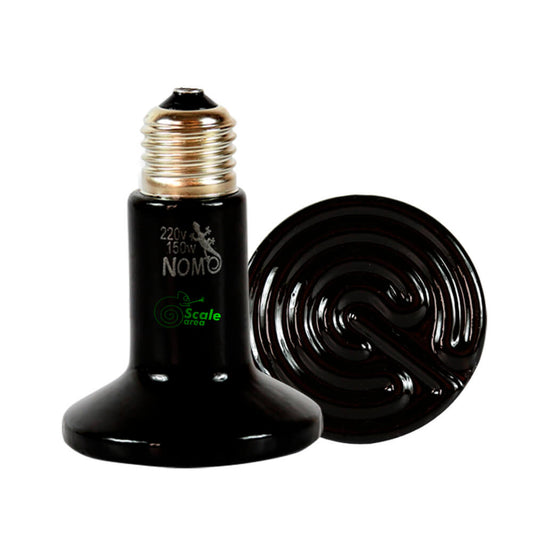
- Ceramic heat emitter (25 to 150 W): infrared heat without light, for night-time or as extra heat in cool zones without disturbing the animal's rest.
- Mini halogen bulb 50 W: heat, light, UVA and a small amount of UVB 3.0 in a compact format, for small terrariums or as secondary heat.
The higher the wattage, the more heat. The right wattage depends on the size and material of the terrarium, and should always be checked with a thermometer in the basking zone.
Heat bulb or heat mat?
For most reptiles, the main heat source is a bulb from above, and the heat mat is a complement. Heating from above replicates the sun: it warms surfaces directly and creates a thermal gradient with warm and cool zones so the reptile can choose its temperature. Relying solely on a mat can create unnatural hot spots.
At night, however, there should be no heat source that emits light, because it disrupts the day-night cycle. Many species cope well with the night-time drop: the bearded dragon down to 18-20 °C, the leopard gecko between 18 and 22 °C, and the chameleon down to 16 °C with no extra heat at all. Only if the house is very cold is a ceramic heat emitter or a mat used, always with a thermostat. For example, a PVC or wooden terrarium insulates better than a glass one and needs less heating in winter.