What are the advantages of a PVC terrarium?
A PVC terrarium is a terrarium made from rigid PVC panels, usually white, with glass doors at the front. Its main advantage over glass is that it insulates heat: the walls do not lose it to the outside, so the temperature gradient is more stable and electricity consumption is lower. In our leopard gecko guide we recommend it as one of the best options for this reason; a glass terrarium works, but it loses heat more easily, especially in winter.
The PVC terrariums in this collection have 10 mm thick panels, sliding glass doors and cross ventilation. They are also lightweight, easy to clean and stackable, so you can build tidy racks of terrariums. They are delivered flat-packed and are assembled with a single screwdriver.
What PVC terrarium sizes are there?
PVC terrariums are made in a horizontal format, for terrestrial species, and a vertical format, for arboreal species. These are the sizes in the collection:
- Horizontal white PVC: 40 × 40 × 80 cm and 50 × 50 × 100 cm, with two cable ports for fitting ceramic lamp holders.
- Vertical white PVC: 30 × 30 × 45 cm, with top ventilation so the lighting can sit outside, and 45 × 45 × 60 cm, with two cable ports in the roof.
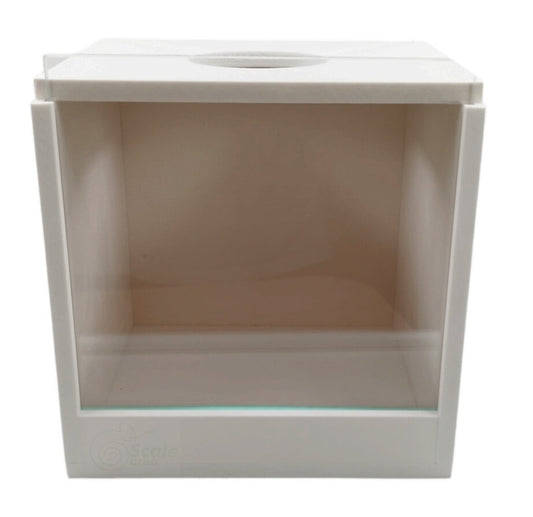
- Mini PVC for invertebrates: 22 × 22 × 22 cm and 22 × 22 × 32 cm, 1 cm thick with a glass guillotine door.
The availability of each size is shown on its product page. When choosing, the rule is to go by the adult animal, not the juvenile: that way you avoid having to change terrarium later.
Horizontal or vertical PVC terrarium?
A horizontal terrarium is for ground-dwelling reptiles and a vertical one is for arboreal species. The difference shows in the minimum dimensions we give in our guides. For example, the leopard gecko lives on the ground and needs at least 60 × 40 × 40 cm, and 40 cm of height is more than enough. The crested gecko climbs and needs at least 30 × 30 × 45 cm, with more height than floor space.
- Horizontal: leopard gecko (Eublepharis macularius), bearded dragons, tortoises, ground-dwelling snakes or uromastyx.
- Vertical: crested gecko (Correlophus ciliatus) and other climbing reptiles, amphibians and invertebrates.
For an adult Pogona vitticeps, the guide recommends a minimum of 120 × 60 × 60 cm, larger than the models in this collection; the 50 × 50 × 100 cm horizontal model meets the dimensions for a hatchling (60 × 45 × 45 cm) or an adult Pogona henrylawsoni (90 × 45 × 45 cm).
Which plastic terrarium should you choose for invertebrates?
For invertebrates, a plastic or mini PVC terrarium is the most practical option: it takes up little space, ventilates well and is easy to clean. The size is worked out with the same rule we use for mantises and phasmids: at least 3 times the insect's length in height and 2 times in width.
- Mini PVC terrarium: for mantises of all species, phasmids, small tarantulas and scorpions, or juvenile reptiles and amphibians. For example, the 22 × 22 × 32 cm one is suitable for a mantis up to 10 cm.
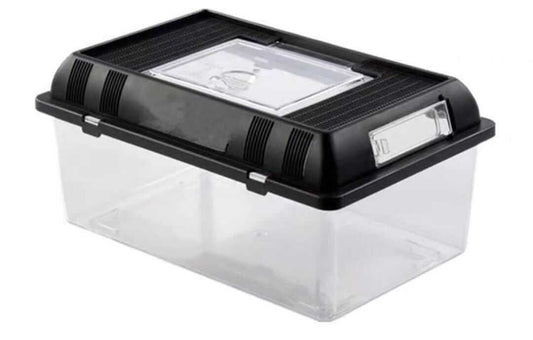
- Low plastic terrarium (30.2 × 19.6 × 14.7 cm and other sizes): for insects, arachnids and small reptiles, or as a quarantine and transport terrarium.
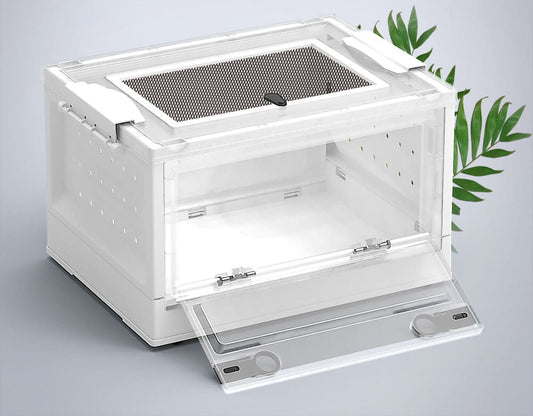
- Folding plastic terrarium (29.5 × 39.5 × 24 cm): with a front door, top opening and mesh roof, for phasmids, mantises, frogs or small reptiles.
How do you fit lighting in a PVC terrarium?
To fit lighting in a PVC terrarium, you either hang the ceramic lamp holders inside, through the cable ports in the top, or place the lamp outside, on the ventilation grille. The 45 × 45 × 60 cm horizontal and vertical models come with two cable ports. The 30 × 30 × 45 cm vertical model has top ventilation so the lamp can sit outside without taking up space inside.
The important thing is that there is no glass or plastic between the UVB tube and the animal, because they filter the radiation. A compact UVB bulb is placed 20-30 cm from the animal, and the lamp holder must be ceramic when it holds heat lamps. The thermostat probe goes in the warm zone, where the animal receives the heat. You will find all the lamps in UVB lighting and step-by-step set-up in our leopard gecko terrarium guide.